Emotional healing and unique biology
We often talk about health, fitness, wellness and emotional healing as if there’s one formula that works for everyone — but life often shows us that this perspective isn’t always correct.
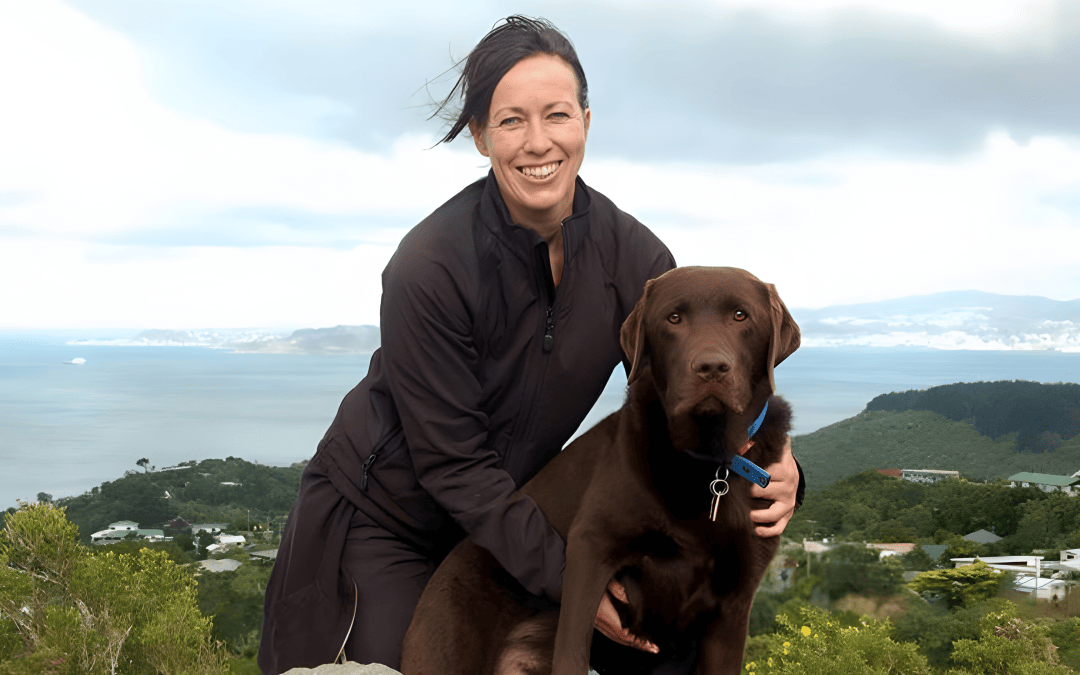
I was reminded of that the day I lost my dog, Utah. He wasn’t just a pet; he was my family, my shadow, my safe space and an incentive to get up and move every day. Losing him was the hardest experience of my life — and it showed me just how unique our emotional needs are, and how for me, connection is vital in navigating loss and emotional recovery.
In those first days without him, my whole body felt it. The ache wasn’t just emotional — it was physical. My energy dropped, my nervous system felt wired and exhausted all at once. My appetite, which is usually strong, completely changed. It reminded me that grief doesn’t live only in the heart; it lives in the body too.
We are all unique
Each of us is structured differently — biologically, emotionally and physically. Our hormones, nervous systems and coping mechanisms all work in their own unique ways. What soothes one person in grief might feel unbearable to someone else. Even a cancer treatment can work for one body and not for another. Some people lose weight on a diet while others gain, and the same fitness plan can help some get fitter but leave others less so. That’s why understanding your unique biology is so important: there’s no universal solution for health, wellbeing, or emotional recovery.
Our bodies are different.
Our needs are different.
And our pathways to healing are deeply personal.
Utah became a seamless part of my life and made our house our home. For 14 years, we shared a full, adventurous life. We even appeared together on TV1 news in New Zealand for Get Fit with Your Dog, the first exercise class for owners and their dogs. Utah brought joy wherever he went — visiting retirement homes, making friends with everyone he met and brightening the days of those around him.
We spent weekends away at baches with friends, explored countless cafés and walked all over the region. Every day with him was full of movement, laughter, love and connection.
Caring for Utah
Utah had joint issues for years, and I dedicated myself to keeping him in the best possible shape. I researched the right supplements, exercises and diet for his needs. I became his personal trainer, chef, massage therapist and wellness advocate. Caring for him gave me purpose, a sense of identity and family — especially when my human family lived far overseas.
When he passed, I did what I always do — I got busy.
I donated his unused medications back to the vet, cancelled his insurance and registration, washed and put away his bowls and gave away his food and treats. I cleaned, organised and handled the practical details. I did things that didn’t need doing straight away — things others might have put off until they were ready — but I needed to do them immediately.
Coping through action
Doing things gave me a sense of control when my heart felt like chaos.
For me, action is a way to process emotion — if I’m moving, I’m not overthinking. It was the right coping method for me in that moment, though it might not be the same for you. Everyone’s biology and way of navigating grief is different, and that’s okay. Because for my body type, motion is medicine. Action regulates emotion. But when the doing stopped — when there was nothing left to fix or clean — the silence hit.
And that’s when the real grief began.
Some friends didn’t know what to say — and honestly, I wouldn’t have known what to say to myself either. Others said nothing at all. Some were beyond supportive and made me feel so loved. Then, people I barely knew reached out with messages of support.
Many assumed I needed space, as is often the default when someone loses a loved one. But space was the last thing I needed — there was already too much emptiness at home.
Healing by connection
What I truly needed was connection. Losing Utah had created the biggest sense of disconnection I had ever felt. For me, connection wasn’t just comforting; it was essential for processing my grief and supporting my emotional wellbeing.
If I went by societal expectations — the unspoken rule that says you should avoid talking about loss because it makes others uncomfortable — I’d be in a terrible physical and mental space. For my body type, silence creates inner stress; it disconnects me from the very thing that helps me heal.
So I kept talking about him, mostly on social media. I shared photos, memories and moments— partly to process, but mostly to stay connected, to him and to the outside world. The world went quiet while my heart was still so loud with love.
Though the grief process, I was meditating, journalling, sleeping amazingly well, exercising, and cooking meals — though still indulging in more chocolate than I normally would, knowing in my head that soon I would need to stop. Even though I was doing all the “good” things for my health, the deep need for emotional release wasn’t always met fully. Not everyone’s perspective aligned with my way of coping, and it made some people uncomfortable. My way is working though, because usually when I am anxious or stressed, it is my joints that feel the strain. But the release I’ve found through this process has had a very positive impact — my joints actually feel freer than usual.
I need physical comfort. At the end of the day, when things are quiet, holding his soft toy gives me a sense of closeness and grounding — a way for my body to feel connection even when he’s gone.
Grief lives in the body
When we lose connection — to others, to purpose, to ourselves — the body feels it, mine does anyway. Our hormones, immune system and nervous system all respond to loss. Just as movement or nutrition can support physical recovery, connection can support emotional healing — though not in the same way for everyone.
Some people need close family nearby, while others need to be completely alone.
Some need quiet and reflection.
Some need to talk, share, or be held.
There is no right or wrong way to grieve — only what’s right for you.
Unexpected source of strength
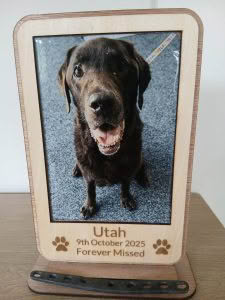
Before Utah’s euthanasia, the vet asked about my wishes. Instinctively, I asked for the metal implant from his leg — the one that had given him strength for six years after major surgery to repair torn ligaments when he was eight.
I didn’t fully understand why I wanted it at the time, but I’m so glad I followed my instincts. The implant was included with his ashes, and holding it gave me a tangible connection to him. It had supported his strength for years, and now it was giving me strength. Something physical to touch and hold was grounding for my body in a way nothing else could be.
I didn’t feel the same connection to the ashes themselves. My body knew what it needed — not to keep him in one place, but to let him be everywhere. So instead of keeping them at home, I scattered them in many of the places we had walked together, letting him return to the spaces where we’d shared so many adventures.
Grief isn’t something you can fix
I’m used to fixing things — in myself, in Utah — but grief isn’t something you can fix. What it has given me instead is understanding of my unique needs for happiness. I am not there yet.
I am far from feeling whole again. At the time of writing, it’s only just over a month since I lost him, and I know I still have a long road to travel. People almost expect me to be “better” by now, asking if I am, as if a few weeks is enough time to process something so big. Grief is a topic many aren’t comfortable talking about, but it needs to be — because it’s something we all go through, in our own way, on our own timeline.
Healing isn’t about solving or rushing through it. It’s about understanding how you work — physically, mentally, and emotionally — and giving yourself what you truly need to recover and feel whole again.
Utah taught me how to live fully in the moment.
Now he’s teaching me how to be in the moment — to sit with my grief, face it, and allow it, rather than try to hide from it.
Emotional Release and Personal Expression
Everyone experiences grief differently, and you may not need the same connection or emotional exchange that I do. For me, I need to express my feelings — for my body type, holding things in creates inner tension and stress. I also need physical touch, which is why his stuffed toy helps me feel grounded at the end of the day. What matters is finding strategies and approaches that are suited to your own body, biology and way of processing.
Personalised Health: Understanding How You Work Best
If you want to experience the difference personalised health can make, it starts with understanding your own biology — how your body responds to food, exercise, stress and connection. When you work with your unique design instead of following one-size-fits-all advice, healing becomes easier, energy flows more naturally and you gain insight into navigating grief and managing stress.
A Note of Gratitude
Thank you for reading. Writing this was incredibly cathartic for me, and I appreciate you taking the time to engage with it. Some of you may feel uncomfortable reading this, and that’s okay. We are all different, but being different doesn’t mean we can’t honour, accept and respect each other’s experiences.
About Rachel Marks
Through her coaching practice, Rachel Marks helps people uncover their personal blueprint for health and wellbeing so they can make choices that truly work for them. She is the creator of the world’s first personalised online wellbeing programme based on your genes. Using insights into your unique biology, Rachel supports people not only with movement, nutrition and stress management, but also with strategies to navigate life’s challenges. Her personalised approach empowers her clients to thrive — physically, emotionally and mentally.